Case Study · Hardware × AI
Ocuvision/ NuroOne
AI-powered smart glasses for intelligence in the physical world.
A wearable that tries to move intelligence off the screen and into your line of sight. The interesting part isn't the model. It's designing hardware, sensors and software together so real-time assistance is actually possible on a device you can wear.
- Role
- Founder & CTO
- Focus
- AIHardwareEmbedded SystemsComputer VisionWearables
Ocuvision
AI-powered smart glasses for intelligence in the physical world.
The problem
Almost all of our intelligence lives behind a rectangle we have to hold. To ask a question about the world in front of you, you first have to stop looking at it, pull out a phone, and translate the physical into the digital by hand.
The device sits between you and the world instead of alongside it.
What made the problem interesting
Smart glasses are a genuine hardware-software co-design problem. Weight, heat, battery, compute and optics all trade against each other, and a decision in one immediately constrains the others.
It is the kind of problem that only becomes tractable when you are willing to design the silicon path, the sensors and the software as one system rather than three.
The hypothesis
If a wearable can perceive what you're looking at and respond in real time, then the interface can start to disappear: assistance arrives without a screen, a tap or an explicit query.
The product
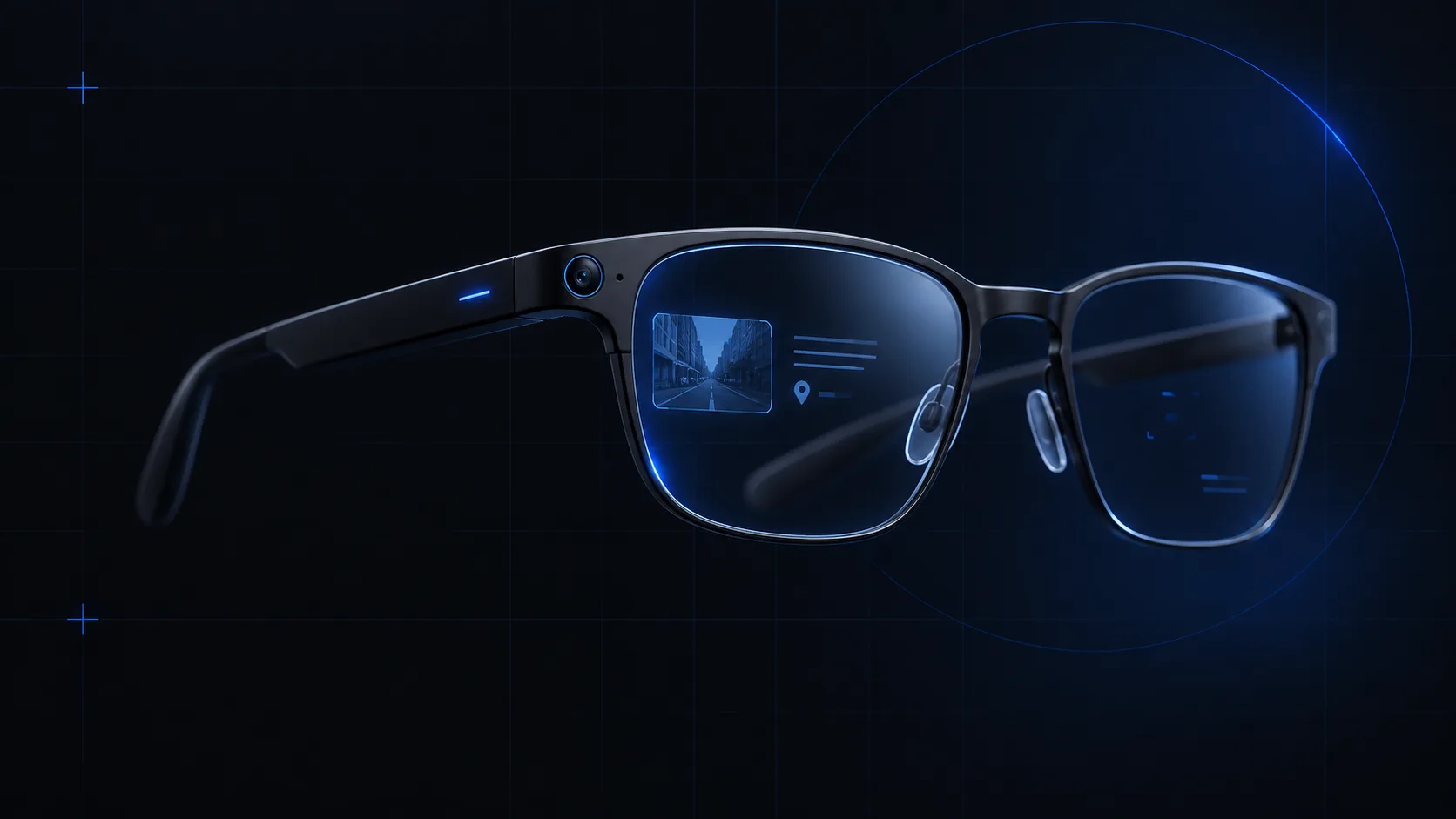
A pair of glasses with a camera and onboard compute, paired with software that turns what the device sees into real-time assistance: reading, recognising and describing the environment.
How it works
A capture pipeline feeds frames into vision models. Latency-sensitive work is pushed on-device; heavier work can be offloaded. The output is delivered in the moment, in context, without asking the wearer to look elsewhere.
System architecture
Sensing (camera + onboard compute) → perception (computer vision + models) → delivery (real-time feedback to the wearer). A companion layer handles configuration and heavier processing.
RISC-V is part of the exploration here as an open, adaptable compute path for embedded, power-constrained AI.
Technical decisions
Split the workload by latency budget: what must be instant runs on-device; what can wait is offloaded. Treat power as a first-class design constraint, not an afterthought.
Explore RISC-V rather than defaulting to a closed stack, because a wearable's constraints reward being able to shape the compute path.
What happened in the real world
The hard, honest truth of hardware: the gap between a working bench prototype and something wearable all day is enormous, and most of it is thermal, power and ergonomic rather than algorithmic.
TODO: verify any specific prototype milestones, accuracy figures or demos before stating them here.
Distribution / adoption challenges
Wearables ask people to change what they put on their face, a high bar. The product has to earn that with a single, obvious, repeated reason to wear it, not a list of capabilities.
What I learned
Hardware humbles you on timelines. And a wearable lives or dies on one killer use case long before it deserves to be a platform.
What I would change
Pick one narrow, high-value scenario and design the entire first device around it, instead of building a general-purpose vision wearable and hoping a use case emerges.
What's next
Continue treating this as the clearest expression of the thesis: intelligence that perceives context and lives in the physical world, not in another app.
More work